
POOR MAN’S ROTH CONVERSION™: A Tax Planning Service for Retired Couples
Overview
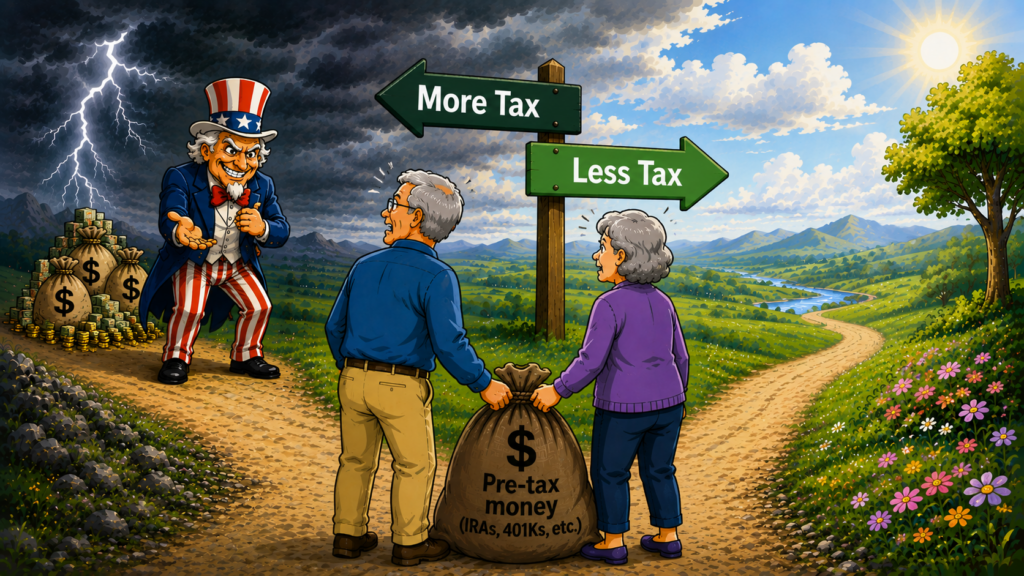
The POOR MAN’S ROTH CONVERSION™ is a retirement planning service we designed to help retirees manage the tax risk linked to the first spouse’s passing. That is, surviving spouses have to file taxes individually, rather than married-filing-jointly (MFJ), and this often results in paying higher taxes.
The reference to “POOR” stems from the underlying strategy’s ability to effectively convert pre-tax money to post-tax without paying taxes. That is, you could be cash poor with no money to pay for a standard Roth conversion, but still benefit from our POOR MAN’S ROTH CONVERSION™ service.
Background: The Roth conversion
Traditional IRAs, 401(k)s, 403(b)s, etc. offer valuable tax deferral. That is, contributions to pre-tax accounts can shield earnings from taxes and allow investments to grow on a tax-deferred basis. Of course, that money is ultimately taxed when it is distributed.
When the time comes, withdrawals from traditional retirement accounts are generally taxed as ordinary income. In particular, required minimum distributions (RMDs) can often force retirees to recognize taxable income whether they need the money or not. This additional income can push them into higher tax brackets, make more of their Social Security benefits taxable, increase the tax on their capital gains, and make their Medicare more expensive (i.e., IRMAA!).
Note: Qualified charitable distributions (QCDs) are one exception to this rule. However, we discuss those on our Charitable Giving page.
One potential strategy we can use to mitigate future tax risk from traditional retirement accounts is Roth conversions. That is, you convert money from a traditional pre-tax retirement account to a post-tax Roth account by voluntarily paying the tax on the conversion upfront, rather than waiting until later.
There are a variety of factors to consider with Roth conversions. We discuss many of them on this page and in this video, but the 800lb gorilla is usually the tax rate you’d pay on the conversion versus what you might pay later.
One key application where Roth conversions often make sense is for married couples, as surviving spouses will start filing taxes individually instead of married-filing-jointly (MFJ). That is, distributions from traditional, pre-tax retirement accounts may be exposed to higher tax brackets.
It is common for surviving spouses to end up with less income (e.g., lose a Social Security benefit), but end up paying more in taxes. This phenomenon is known as The Widow’s Tax. This risk is especially applicable to those with significant age differences and/or large pre-tax balances, as the negative consequences can be amplified by the sheer amount of money or by the length of time a surviving spouse is alive and subject to the risk.
The POOR MAN’S ROTH CONVERSION™ service
Our POOR MAN’S ROTH CONVERSION™ service can be even more effective than executing standard Roth conversions. At the same time, the two underlying strategies can often be used together to maximize the tax savings.
As we highlighted above, taxes are inextricably linked to lifespans, since surviving spouses will have to start filing taxes individually. This means their standard deduction will be cut in half, as will the size of their tax brackets. In other words, their taxes will likely go up. This phenomenon is well known and called The Widow’s Tax.
Given that taxes are dependent on lifespans, we looked into investment products that were also linked to lifespans:
- Annuities: Money until you die
- Life insurance: Money when you die
These are the key tools we use with our POOR MAN’S ROTH CONVERSION™ tax service. In particular, our goal is to structure these products in such a way that we
- Optimize the use of the higher tax capacity while both spouses are alive, and thus benefit from their MFJ tax status
- Reduce the surviving spouse’s potential tax burden stemming from traditional retirement accounts (i.e., mitigate The Widow’s Tax)
Let’s consider a hypothetical couple whereby spouse A has a significant traditional IRA balance, and is concerned that their spouse (spouse B) could be negatively impacted if they were to pass (i.e., they’d be exposed to The Widow’s Tax).
Our POOR MAN’S ROTH CONVERSION™ planning service would consider purchasing an annuity with a portion of their traditional IRA funds. While many couples naturally opt for the joint-life payout, this strategy would utilize the single-life payout. That is, spouse A would select the payout that only pays out as long as they are alive.
On the surface, this might sound risky, as it could expose spouse be to a financial loss in the event of spouse A passing. However, the single-life payout is typically significantly higher than the joint-life payout, and the second part of this strategy is to purchase life insurance. In particular, we could use the “delta” between the single- and joint-life payouts to purchase the life insurance.
This way, the annuity might stop paying when spouse A passes, but spouse B would also receive the proceeds from the life insurance. This is where the magic happens! The money from the traditional IRA that was used to purchase the annuity might disappear. However, it would effectively reappear in the post-tax world in the form of a tax-free death benefit.
In short, our POOR MAN’S ROTH CONVERSION™ planning service effectively “converts” pre-tax money from the traditional IRA into a tax-free death benefit. However, this did not require a corresponding tax payment, as would be the case with regular Roth conversions.
Of course, we have to make sure the economics of the annuity and life insurance cash flows are attractive. We don’t want to lose on the investment side just to save on taxes. Ideally, the cash-flow economics would be competitive or better than those of other fixed-income investments (e.g., bonds and bond ladders). That way, the tax benefits would effectively come for free.
Logistics
There are four primary steps within our POOR MAN’S ROTH CONVERSION™ service:
- Assess the compatibility of your financial situation
- Determine which types of life insurance and annuities make the most sense, and obtain quotes
- Analyze the cash-flow economics to see whether or not they make sense (i.e., provide returns that are comparable, or better, than those with current interest rates and bonds)
- Assess the potential tax benefits
If the benefits look attractive and you are interested in pursuing this strategy, we help you execute it.
Summary
On balance, we view the POOR MAN’S ROTH CONVERSION™ service as a form of insurance against tax risk. It may be worth considering for retirees and near-retirees who:
- Are married and concerned about The Widow’s Tax
- Have significant traditional IRA, 401(k), or other pre-tax balances
- Are concerned about future RMDs
- Expect future tax rates to be higher
- Are considering executing Roth conversions
- Are concerned about the immediate tax bill created by Roth conversions
- Want predictable retirement income
Interested in the POOR MAN’S ROTH CONVERSION™ service?
If you share one or more of the concerns highlighted above, please feel free to schedule a complimentary consultation. We can explore whether the POOR MAN’S ROTH CONVERSION™ (or other retirement planning strategies) may be appropriate for your situation, and help you execute them.